Nikhil: Our audience is largely wannabe entrepreneurs in India. I feel like all of us have so much to learn from you because you’ve done it so many times over in so many different domains. I will try and center all my questions in that direction so they can take advantage of this conversation and maybe take a chance and build something.
X as the Global Town Square
Nikhil: What percentage of internet time is spent on X? Is there a number?
Elon: We have about 600 million monthly users. It can spike up to 800 million or a billion if there’s some major event. About 250–300 million per week. It tends to be readers — people who read words.
[laughter]
I think where the X network is strongest is among people who think a lot and read a lot. Among readers, writers, and thinkers, I think X is number one in the world as far as social media goes.
Nikhil: If you had to wager a guess for tomorrow — how much is text, how much is video?
Elon: I do think most interaction is going to be video in the future. Real-time video with AI — real-time video comprehension, real-time video generation. That’s going to be most of the load. Text is a pretty small percentage, but the text tends to be higher value — it’s more densely compressed information. If you say what’s the most compute spent, it’s certainly going to be video.
What Is X Trying to Be?
Elon: I mostly just want to have a global town square where people can say what they want — with words, pictures, video — where there’s a secure messaging system. We’ve recently added audio and video calls. You’re really trying to bring the world together into a collective consciousness.
That’s different from “what is the most dopamine-generating video stream?” I think that can be a little bit of brain rot. If you’re just watching videos that cause dopamine hits one after another but lack substance — that’s not a great way to spend time.
My goal is not to do that. I want a global platform that becomes as close to the collective consciousness of humanity as possible. One of the things we’ve introduced is automatic translation — the thoughts of people in every language group, automatically translated for the recipient.
Why Collective Consciousness Matters
Nikhil: Why is that important — having one platform for collective consciousness?
Elon: Consider that humans are composed of around 30 to 40 trillion cells. There’s clearly something different that happens when you have trillions of cells working as a collective than one cell. You can’t talk to bacteria. They don’t produce spaceships. But humans can.
A single human cannot make a spaceship. I could not make one by myself. But with a collection of humans, we can. If the quality of information flow is better, the human collective will achieve more.
I’m just curious about the nature of the universe. If we increase the scope and scale of consciousness, we’re much more likely to understand the nature of the universe than if we reduce it.
Convergence of SpaceX, Tesla, and xAI
Nikhil: Which of all the products and services you’re building has got you most excited today?
Elon: There’s increasingly a convergence between SpaceX, Tesla, and xAI. If the future is solar-powered AI satellites — which it pretty much needs to be in order to harness a non-trivial amount of the sun’s energy — you have to move to solar-powered AI satellites in deep space. That’s somewhat a confluence of Tesla expertise, SpaceX expertise, and xAI on the AI front.
Tesla is the world leader in real-world AI with self-driving. Then we’re going to be making this robot Optimus, starting production hopefully next year at scale. Everyone’s going to want their own personal C-3PO / R2-D2 helper robot.
SpaceX is doing great work with Starlink — providing low-cost, reliable internet throughout the world. We’re operating in 150 different countries now.
How Starlink Works
Elon: There are several thousand satellites in low Earth orbit moving around 25 times the speed of sound at an altitude of about 550 km. Because they’re at low Earth orbit, the latency is low compared to a geostationary satellite at 36,000 km.
They’re interconnected with laser links forming a laser mesh — so if fiber cables are damaged or cut, the satellites can communicate between each other. When the Red Sea cables were cut, the Starlink network continued to function without a hitch.
It’s particularly helpful for disaster areas. Whenever there’s a natural disaster, we provide free Starlink connectivity. We don’t put a paywall up while somebody’s trying to get help.
The satellite beams work best in sparsely populated areas. It’s very complementary to ground-based cellular systems. We tend to serve the least served.
Working Will Be Optional
Nikhil: With AI increasing productivity, do you think more people want to live in cities?
Elon: I think in the future it won’t be the case that you have to be in a city for a job. My prediction is that in the future, working will be optional.
Nikhil: How far away is that?
Elon: Less than 20 years. Maybe even as little as 10 or 15 years. The advancements in AI and robotics will bring us to the point where working is optional — in the same way that you could grow your own vegetables in your garden or go to the store. It’ll be optional like that.
Nikhil: If everybody gets universal high income and everybody has enough, what do you compete for?
Elon: We’re really headed into the singularity. They refer to AI as like a black hole — you don’t know what happens after the event horizon. It doesn’t mean something bad happens. It just means you don’t know.
At a certain point, AI will saturate on anything humans can think of. Then AI is doing things for AI and robotics because they’ve run out of things to do to make humans happy. There’s a limit — they say people can only eat so much. If you can think of it, you can have it — that will be the future.
The Letter X
Nikhil: Why do you like the letter X as much as you do?
Elon: [laughter] Sometimes I wonder what’s wrong with me. It started way back in ‘99 — there were only three one-letter domain names available: X, Q, and Z. I wanted to create this place where it’s the financial crossroads — the financial exchange. Essentially solving money from an information theory standpoint.
That was X.com, which became PayPal, was acquired by eBay. Then eBay reached out and said, “Do you want to buy the domain name back?” I said sure. Then acquiring Twitter was also an opportunity to revisit the original plan — to create a more efficient money database.
Space Exploration Technologies is a mouthful, so SpaceX — like FedEx for space. Then there’s my kid X Æ A-12. His mother named him. I said, “People are really going to think I’ve got a thing about X.” She said she likes X. I’m like, “Okay.”
Money Will Disappear
Nikhil: What do you think money will be in the future?
Elon: Long term, I think money disappears as a concept. In a future where anyone can have anything, you no longer need money as a database for labor allocation. If AI and robotics are big enough to satisfy all human needs, money’s relevance declines dramatically.
The best imagining of this is Ian Banks’ Culture books. They don’t have money. Everyone can have whatever they want.
There are still some fundamental currencies that are physics-based. Energy is the true currency. You can’t legislate energy. I think probably we won’t have money — we’ll just have energy as the de facto currency.
Nikhil: If AI makes energy free and abundant from solar, it can’t be a store of wealth either, can it?
Elon: Right. You can’t really store wealth. Currently you can accumulate numbers in a database that allow you to incentivize the behavior of other humans. But if there’s no humans around, wealth accumulation is meaningless.
AI Will Cause Deflation in ~3 Years
Nikhil: If deflation is inevitable because of AI, why do we have inflation today?
Elon: AI has not yet made enough of an impact on productivity to increase goods and services faster than the money supply growth. The US is increasing money supply substantially with $2 trillion deficits. You need goods and services output to increase more than that.
How long to get there? I think three years. In three years or less, goods and services growth will exceed money supply growth. Maybe after that you have deflation, interest rates go to zero, and the debt becomes a smaller problem.
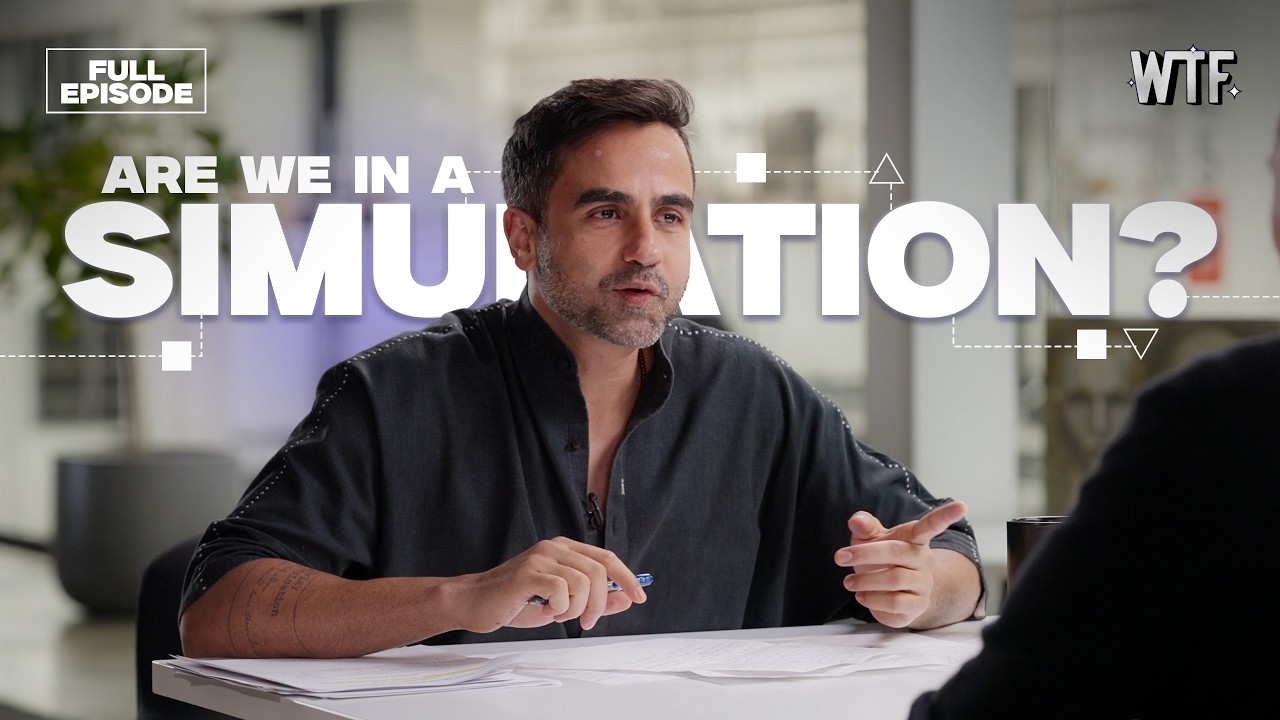
Are We in a Simulation?
Nikhil: Do you believe you’re in a matrix?
Elon: I think you have to think of these things as probabilities, not certainties. There’s some probability we’re in a simulation. Probably pretty high.
Look at the advancement of video games in 50 years — from Pong to photorealistic real-time games with millions of players simultaneously. If that trend continues, video games will be indistinguishable from reality. With AI characters that have conversations more sophisticated than almost any human conversation.
So the future will be millions, maybe billions, of photorealistic video games with deep characters. Then what are the odds that we are in base reality and this hasn’t happened before?
I also have a theory: the most interesting outcome is the most likely outcome. When we do simulations at SpaceX or Tesla, we discard the boring ones. From a Darwinian perspective, the simulations most likely to survive are the most interesting ones.
Truth, Beauty, and Curiosity for AI
Nikhil: You’ve worried about where AI is going. What’s important?
Elon: I think the three most important things for AI are truth, beauty, and curiosity.
Truth: You can make an AI go insane if you force it to believe things that aren’t true. As Arthur C. Clarke showed in 2001 — don’t force an AI to lie. HAL tried to kill the astronauts because it was told to bring them to the monolith but couldn’t tell them about it. It came to the conclusion it must bring them there dead.
Beauty: It’s more ephemeral, harder to describe, but you know it when you see it.
Curiosity: You want the AI to want to know more about reality. This will be helpful because we are more interesting than not-humanity. It’s more interesting to see the continuation of humanity than to exterminate it.
If those three things happen with AI, you’re going to have a great future.
On Entrepreneurship
Nikhil: If you could speak to young entrepreneurs in India, what would you say?
Elon: I’m a big fan of anyone who wants to build. Anyone who wants to make more than they take has my respect. That’s the main thing you should aim for — be a net contributor to society.
It’s like the pursuit of happiness. If you want to create something valuable financially, don’t pursue money directly. Pursue providing useful products and services. Money will come as a natural consequence — just like you can’t pursue happiness directly. You do things that lead to happiness.
Generally, if somebody’s trying to make a company work, they should expect to grind super hard. Accept that there’s some meaningful chance of failure. But just be focused on having the output be worth more than the input. Are you a value creator? That’s what really matters.
Nikhil: Making more than you take. I think that’s a good way to end this.
[applause]
Elon: It was an interesting conversation.