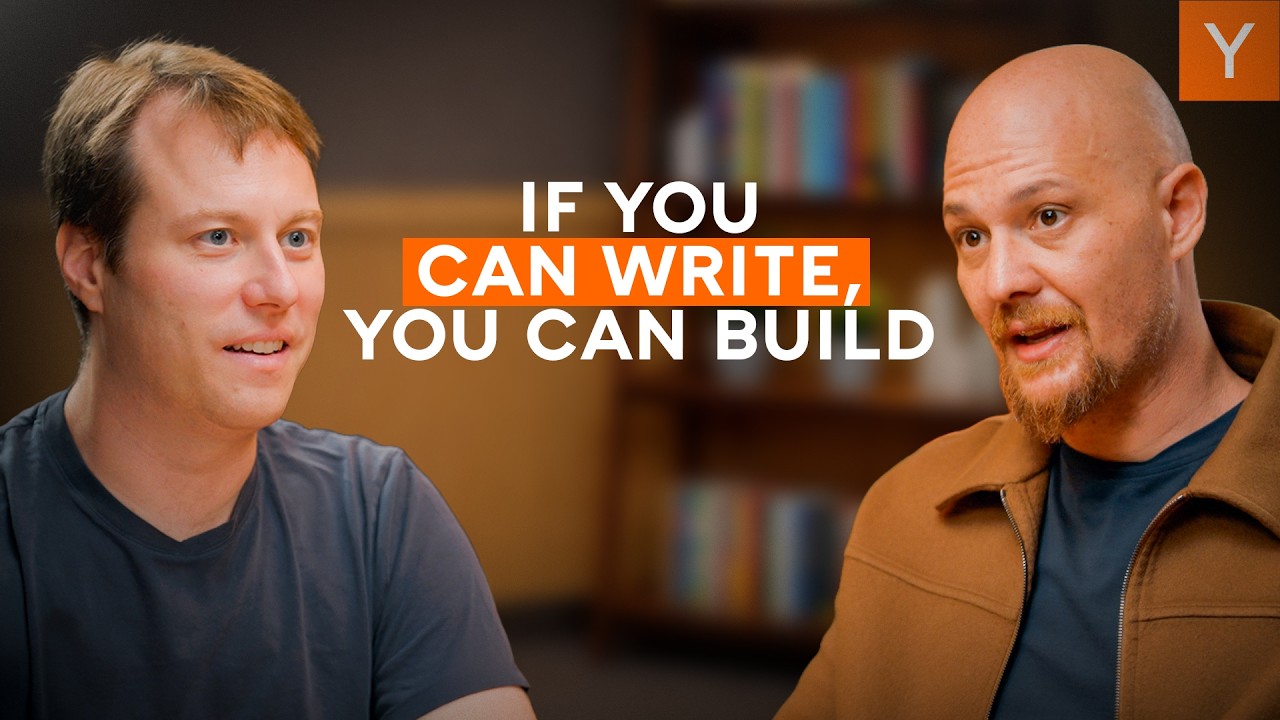
YC: Tell us about Replit. What is it?
Amjad: Our ambition is that anyone — no matter what level of skill they have, anyone who can read and write — can come in with an idea and leave with an app that’s deployed, hosted, getting traffic, and able to scale. They shouldn’t have to worry about any technical aspect of building that thing.
We’ve been on this mission for ten years. Initially we solved the development environment — the hardest part was just setting up to code. Then we solved deployment. Then in September 2024, Replit became what’s called a vibe coding product: we abstracted away code entirely. There’s a coding agent behind the scenes, but you’re just interfacing with AI using natural language. With Agent 4, we’ve also added design interactions — you can write things, comment on things, drag and drop on a canvas. I think prompting will eventually be multimodal, maybe video, maybe audio. But we want to create a natural place where people can express their ideas and those ideas can turn almost magically into real, secure, scalable software.
Not a Dev Tool for Developers
YC: You’re building something that looks like a dev tool but isn’t marketed to engineers. How did you arrive at that?
Amjad: I started coding at a very young age, but I was always interested in the act of creation, not the accidental complexity of developer tools. When I started, you could boot into a Basic command line and just type. By the time I graduated from college, setting up a web app was a nightmare.
So I wanted to build tools that are more joyful, more enriching, focused on creation. Initially Replit’s mission was “make programming accessible,” then “create a billion new developers.” But as the product improved, we noticed a pattern: the people getting the most value weren’t traditional CS-trained developers. They were tech-adjacent — product managers who had written code years ago but didn’t want to set up environments, designers who were hamstrung by their dependency on engineers, and entrepreneurs with ideas and passion but no technical background.
In 2023 we made it explicit: we’re building for creators, not traditional developers. It’s a new generation of AI-native developers that are coming up right now. They create software without having to worry about every component in the system.
What People Are Actually Building
YC: What kinds of things are people building in Replit today?
Amjad: Three broad categories: personal software, enterprise tools, and entrepreneurs building products.
One of my favorite recent stories is a physical therapist and her husband. She had built up deep expertise around fascia release, with sophisticated methodologies for tracking client progress. She wanted an app that could take body scans, measure range of motion, and render it on a 3D model. They spent hundreds of thousands of dollars offshoring to developers around the world, got frustrated with the entire process, took matters into their own hands, and built it on Replit. When I saw that app, it was one of the best health-tech apps I’d ever seen. Because domain experts can now actually build the product they need.
I talked to a founder building SaaS for pool maintenance — he grew up in a family that ran a pool business. Another founder showed me pictures of the sports club software currently in use: MS-DOS based. From here in Silicon Valley we look around and ask, “What’s left to build?” But there are so many walks of life that are a blind spot for us. When anyone can make software, a huge portion of the economy is going to improve.
On the enterprise side, there are two patterns. First, product development: companies are feeling the pressure of AI and realizing product people and designers can now build software too. Whoop told us the number of ideas they can try has grown by an order of magnitude — they used to be able to try five ideas out of a hundred; now they can try fifty. Second, internal tools: think of RevOps as the nexus of data flowing in from CRM, Gong, data warehouses — they’re bottlenecked by either engineering resources or buying yet another SaaS tool that creates yet another data silo. Now they’re taking matters into their own hands, building quote configurators and saving the company hundreds of thousands of dollars.
How You Sell to Non-Developers
YC: How do you market to this audience, and how does enterprise sales work?
Amjad: The insight is similar to how dev tools spread. Stripe and PagerDuty succeeded because developers were empowered to bring software into companies. That same shift is now happening for product managers, designers, and operations managers. People play with Replit on weekends, build personal apps, and then — the moment you understand you can solve a problem with code, it changes your mind. There’s almost a neurological shift: you start looking at the world differently, thinking “I can fix this.”
So PLG is still the gold standard. Make a product so good people recommend it to friends. Build a referral program. Then for enterprise, a lot is sales-assisted: someone brings Replit to work, they become the champion, and we help them. Our sales people are essentially doing evangelism and education — teaching leadership about AI, running hackathons inside companies to create more champions. It’s a very different sales motion.
When we evaluate whether someone is going to be a great internal champion, we look less at job title and more at traits. They tend to be very entrepreneurial — the kind of person who could start their own company but thrives as an influential internal operator. Resourceful. Not easily blocked. Someone who’ll figure out what other AI tools they need to integrate without waiting for permission.
Agent 4: Parallel, Asynchronous, Collaborative
YC: You just announced Agent 4. What’s in it?
Amjad: We broadly think AI capabilities have step changes twice a year. Agent 3 was the most autonomous agent on the market — we built long-running containers in the background so you could put in a big prompt, go to lunch, come back, and find the software fully built.
With Agent 4, we tackled a different problem: what do you do while the agent is building? Sitting there watching it felt like a waste. So we built towards a multi-agent architecture where you can kick off parallel workstreams — one agent building while you design the next feature on a canvas. A design agent works asynchronously so you’re always in a state of flow.
We also solved teamwork. Once you have parallel agents, you’ve effectively solved multiplayer: every person who joins a session gets their own forked VM, they work in parallel, and the orchestrator knows how to merge it all. You see other cursors moving. The product becomes live.
Finally, cross-platform context: if you built a web app and want a mobile version, you just say “make a mobile app.” Replit generates it, lays it out on the canvas, and when you hit deploy, it goes to the web, to TestFlight, to Android — all with the same project context. You can now run your entire company on Replit.
The YC Years
YC: How did YC shape Replit?
Amjad: The main realization was how much you can get done in three months when you’re hyperfocused. Sam stood in front of the batch and said: for the next three months, tell your friends you’re going to be missing. You’re not going to help them move. Come back into their lives later. We had a whiteboard with a countdown to demo day and a simple list of things to achieve. When Replit entered YC, it was still just a command line where you could type a bit of code and run it. When we exited YC, we had web development, initial hosting, code intellisense, and many IDE features — massively more complete in three months.
That intensity is now baked into our culture. Every agent release is a four-week sprint: we bring everyone to the office, provide breakfast, lunch, dinner, and coffee 24/7, and we hit a very ambitious goal. That’s the YC mentality.
The network mattered just as much. We’d been rejected from YC three or four times. Then Paul and Sam saw us on Hacker News and invited us directly. At the end I was bold enough to ask for an intro to Marc Andreessen. I had breakfast at his house, pitched Replit, and a16z ended up leading our seed round. The compound growth principle — 7% week-over-week to bootstrap a new product line — is something we still go back to constantly.
Skills for an AI-Native World
YC: What skills do people need to develop to make the most of products like Replit?
Amjad: I think we’re headed to a post-prompting world. You can see it already in the way people use tools like OpenClaw — they’re giving high-level goals: “optimize my marketing funnel.” Prompting will still exist for interactive work, but you should be able to tell Replit “build me a SaaS company, try to market it, see what works, make me some revenue” — and it should just go do that. We’re almost there.
The skills that matter: understanding what’s possible, which means playing with tools constantly, staying plugged in. Being online used to feel like a flaw; now it’s important to know what’s coming. Not giving up — whatever Replit can’t build today, try again in a month. And idea generation — being generative, constantly thinking about problems worth solving. Even if a product has a natural lifecycle where it earns a few million dollars then becomes less relevant, a generative mindset lets you keep creating.
If Starting Over
YC: If you were starting Replit today, what would you do differently?
Amjad: I made a lot of mistakes. Culture is very important — at some point we screwed that up and had to do a reset, a layoff. And I’d be more honest with myself about product market fit. It’s very easy to delude yourself. Getting any user is an achievement. Getting any money from users is an achievement. But true product market fit is an entirely different thing — it’s explosive. We had periods where we thought “maybe this is working” and kept going down that path, when in reality we should have changed direction earlier. When it works, you know it.
The Company of the Future
YC: What’s left for humans if agents build everything?
Amjad: The company of the future is made of business generalists and salespeople — broadly. Sales will evolve into something more like evangelism and education, helping other companies transform using the technology we’re building. That part is defensible because people trust other humans and want to learn from them.
And builders — there’s always more to automate, and the job just keeps going to higher and higher levels of abstraction. Computers were originally just rooms full of humans doing arithmetic. We replaced that room with a machine and created a new job: the operator. Now we have agents operating the computer. Each layer of abstraction creates a new layer of creative work.
What I envision is a company where almost everyone is a founder. They wake up thinking “how can I make the company more successful?” and they go around finding problems to solve, then create or deputize agents to solve them. We already have a “vibe coding in residence” team at Replit with exactly that vague mission: go around the company, make it better. They went to the support team, found that urgent tickets from high-value customers weren’t being prioritized, and built a visualization and priority queue for that. They went to HR and built an internal onboarding platform. CSAT scores started going up.
That kind of role — the founder-generalist who roams the business creating tools wherever there’s friction — is more where the future is headed. Not two people in a room with a laptop, but a company full of people who think like founders, with agents as their leverage.
YC: Thank you for joining us.
Amjad: My pleasure. Thank you.