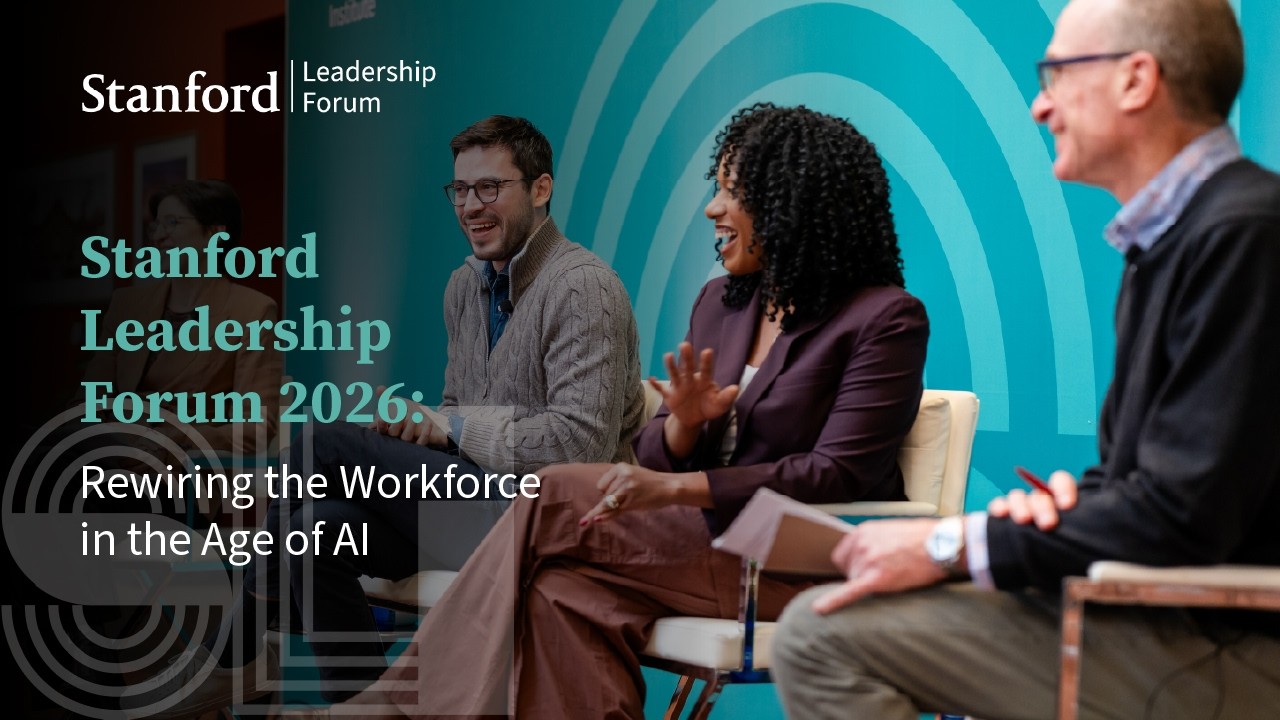
Good morning, everyone. I’m Paul Oyer, a professor of economics here at the Stanford GSB — and merely a moderator today. We are in the interesting position of discussing a transformation while it’s happening, with an audience that includes some of the people directly involved in building it.
Let me introduce the panel. Susan Athey is the economics of technology professor here at Stanford, with deep ties to the tech policy world and a track record as former chief economist of the DOJ’s antitrust division. When I asked Claude to describe her, it said she is “the bridge between economic rigor and the actual boardrooms of big tech.” Nela Richardson is ADP’s chief economist. Her team has access to real payroll and employment data from over 42 million workers — she sees the real-time heartbeat of the American workforce. And Tamer Basaroglu is co-founder of Mechanize, a company explicitly trying to automate knowledge work at scale, which makes his perspective here particularly interesting. He’s been described as “the one tracking the exponential curve of the machines themselves.”
Let’s start with Tamer, since his company’s mission is the provocation at the center of this whole discussion.
Tamer: The Timeline
We build environments for training and evaluation — we teach models how to do knowledge work, with a focus on software engineering right now, which is the domain where AI labs are competing most intensely. We work closely with leading AI labs to advance their models’ capabilities in software engineering, and we want to eventually support the automation of knowledge work more broadly.
My assessment of the timeline: over the next one to five years, I expect a continuation of the gradual automation of tasks that knowledge workers do — in software engineering, consulting, finance, banking, oil and gas, and other domains. I don’t expect a very drastic acceleration in that window. But over one to three decades, I expect very widespread automation — probably the majority of work in the US economy ends up automated.
A concrete prediction economists pay attention to: the labor share of the economy — the fraction of output paid out in wages to workers. I expect that within one to three decades, we’ll spend more on compute than on human workers. And I expect that to be pretty likely.
Susan: Technology Capability vs. Implementation
From an academic perspective, it’s helpful to separate technological capability from implementation and actual change. Great technological improvement only translates into impact when it’s combined with an existing system or organization.
Take drug discovery. AI can widen the pipeline of drug discoveries dramatically, and somebody can show you molecules being generated that blow your mind. But then you have to think: what about the human trials? How do we make the FDA go faster? Eventually, if we’re piling up amazing drugs, we will figure out how to invest in the capacity for trials and change regulations. But some of that requires an act of Congress — political parties being a lot more aligned than they are — and those things can stop progress even when the economic returns are very high.
At the micro level: it just got a lot easier to write emails. Great, I can write them really fast. But what did that do to your inbox? And what did that do to productivity, actually? Everybody is getting spammed. My student is preparing a slide deck for me — done by Claude, looks beautiful — but I can’t tell until I actually read it whether they thought about it. We’re going to have to change how we communicate in business. We will figure it out, but it might be bumpy.
This is a pattern of every general-purpose technology: there’s a technology change, then there are micro complementary innovations — organizational innovations, new norms — and then sectoral factor reallocations. One prods another. It’s iterative. It’s slow.
What am I actually hearing? Students, my MBA class, my own two kids in college — fear. Big fear. You ask who is afraid, and it’s passionate: “I have to choose my career and everything I knew is wiped out.” And that filters down to high school kids and parents.
At the firm level: everybody is trying to figure out how to reorganize. You ask any attorney: “How are we going to train our new associates? What does the world look like?” The organizational change needed to fully take advantage of AI is pretty profound, and most organizations are just at the beginning of that.
One very interesting data point: the most-spammed job opportunity my MBA students were getting on LinkedIn — the thing they were receiving the most outreach for — was “forward deployed product manager.”
Nela: What the Data Actually Shows
I hope the context I’m about to give colors everything. AI is not happening in a vacuum.
ADP pays over 42 million workers around the world. On tax day, we will issue over 80 million W-2s in a quarter. I get to see about one-fifth of the US workforce in real time. Here is what we are actually seeing.
If you look at the last two years, three out of every four US jobs that were newly created came from one super sector: education and health care. The single biggest occupational category seeing those job gains? Home health care aides. Not because of AI — because of aging. We are looking at mass retirements of the boomer population, the wealthiest generation in history, who are choosing to age in place. There is no AI robot that can do their laundry or make them a sandwich. And that is what the customer ultimately wants.
So where the jobs are coming from and where the tech is going — totally different sectors right now.
The US is not unique. Europe is ten years ahead in terms of aging demographics. China, Japan. Southeast Asia is currently at their demographic sweet spot in the labor market, and yet that window is only about ten years long, after which fertility policy will have already set the clock running.
On sentiment: when we survey about 40,000 workers in 36 countries, a significant portion say their jobs are safe from elimination. The US figure is 28%. But our research shows that if you invest in people by upskilling them, that safety number increases by five times. This isn’t the weather. We don’t just need an umbrella. We can actually change the environment we’re in through investment.
On the task level: the concept of “occupation” may become an old idea. We’re already moving toward talking about the kinds of tasks, skills, and activities that define work, and those will be far more fluid. I’ve joked with Erik Brynjolfsson that one day we won’t be talking about a jobs report — we’ll be talking about a task report, the number of tasks created and destroyed. He said: we can do that. So that’s what we’re going to do.
Canaries in the Coal Mine
There is a paper by Erik Brynjolfsson and co-authors using ADP data. They call it the “canaries in the coal mine.” Using ADP’s job title taxonomy, they classified jobs by AI exposure — software developer, customer service agent as high-exposure; home health care aide as low-exposure.
What they found: after the rollout of ChatGPT in October 2022, there is a distinct drop in employment for early-career workers between 22 and 26 in AI-exposed careers. At the same time, for more complex, more tenured, older workers, there is a ramp-up in employment.
So the data does suggest automation of work. But the right framing for HR professionals is not “those jobs just went away” — it’s upskilling young workers to more complex tasks. The paper is really about augmentation, not automation. If you look at older workers doing more complex jobs, you see employment growth. I actually thought AI would get rid of the expensive older people first. Apparently not.
AI is not getting rid of me. It’s going after my kid who’s going to graduate into a role that no longer exists. That is what we should be concerned about — upskilling youth to take advantage of a tool they are natively built to use. Not for the old jobs we educated them for, but for the new tasks coming.
Is This Wave Different?
Tamer: In software engineering specifically, there’s been decades of automation that looks fairly similar. First, compilers automated the writing of machine code. Then higher-level languages like Python abstracted away assembly. In the 2000s, web developers spent many hours writing boilerplate code that a single import statement now handles in milliseconds. AI feels like a continuation of this long run trend toward higher and higher levels of abstraction.
What’s different is that compilers and high-level languages don’t promise to fully automate everything a software engineer can do. AI, I think, eventually will. That will take a couple of decades. But that is a very big difference from prior technologies.
At Mechanize, we are actually aggressively hiring junior software engineers right now — looking to hire around fifty this year. But the skills we look for are very different from two years ago. We explicitly evaluate, during the interview process, people’s ability to use things like Claude Code, to make a lot of progress, and still understand the code being produced. The candidates who are very good at that are enormously productive. They just generate a lot of value.
Susan: On what young people should do: my son is a STEM major — math, physics, not much coding. A year ago he was in the worried camp. Then he got involved with a startup. When he got his offer letter, it said “forward deployed engineer.” I’m not sure he knew what that was until he saw it. But they wanted him not for a specific technical skill set — they wanted him because he was a problem solver. Someone who can break down a problem into components and solve it.
If you have an idea about how to conceptualize and solve a problem, break it down, measure, and test, you have these AI tools that can make that idea a reality. And there is enormous demand for that right now.
If you think about all the people globally who were doing back-office IT work for big firms — it’s at least a ten-year journey to digitize and redo the IT stack of every organization in the world, and to create IT stacks for organizations that have never had them. This feels like a big expansion before it contracts.
The Developing World Opportunity
Susan: One of my current projects is co-advising the World Development Report 2026 on artificial intelligence, which will inform World Bank policy for developing countries. A few facts that really focused my mind:
In the developing world, depending on the country, between 50 and 70% of people work in one-person or one-family firms. The employer is the worker. When you think about that, automation just makes those small businesses more productive. It allows them to grow.
Think about a small retail shop with a camera watching what goes in and out — now you have inventory. A WhatsApp bot — now you have customer orders, supply management, without doing a thing. The advice five years ago was: to digitize, you have to do A, then B, then C, then D, and each step is expensive and by the time you finish, it might be obsolete. Now, AI makes adoption in principle so much easier.
Think about health care and education. In developing countries, nurses may not have high school education. Teachers are teaching science without science training. The ability to upskill those service workers — who then have positive externalities through the whole economy — is enormous. If you can make all agricultural workers 5% healthier, that goes one-for-one into output.
A lot of development economists say: here’s another technology that’s going to widen the gap between rich and poor. It could. It absolutely could. But it doesn’t have to. And this is one of the few times in my lifetime where a relatively small amount of dollars with relatively high ROI could actually improve the lives of a billion people. We may fail to execute, but the opportunity is profound.
Inequality and Political Risk
Nela: I have to question the business model of destroying your customer base. If you destroy the worker, you destroy the consumer, and we’re still a consumer-led economy. Taking any of these scenarios to their ultimate conclusion ends in nihilism — no workers, no consumers, no economy, and in my view, no society, because society is based on transactions and commerce and relationships. That is not, in my view, a likely outcome.
What I think is more likely: we have to give up the notion that knowledge work is the only kind of work. Maybe knowledge work was already on a path to extinction well before ChatGPT and Claude came into the picture. Maybe we set up our youth for an economy that was going to disappear in 20 years anyway, because that’s what economies do. They constantly evolve, and AI is one more ramification of that change.
The task at hand is to define the task of AI. We have to break jobs down into their component tasks, price the value of each task, and tell employers and workers clearly: here are the higher-value tasks, here are the lower-value tasks, and here is how they’re changing over time. That way, we can go to a college campus and say — specifically, with data — these are the skills you will need to be competitive in this industry over the next decade.
Susan: From a political economy perspective: when I was at DOJ, I spent two years commenting on AI policy. Every document said the same thing: this may impede new business formation, this may benefit incumbents and reduce competition. For developing countries, the risk is even more acute — they feel helpless, want to protect themselves, but if they over-regulate, nobody will serve them at all.
There is a real risk that fear gets ahead of benefits, and we incapacitate ourselves from solving global problems through the electoral choices we make. People’s core concerns — I can’t get a doctor’s appointment, grandma can’t get a doctor’s appointment, I can’t afford to move to a better school district — these are not being addressed. And when people get scared of change, they react strongly, and it doesn’t always lead to the long-term investments that solve the problem.
Tamer: We see enormous variance in how well people can use AI tools, and that translates directly into enormous variance in productivity. In our hiring process, we give a take-home assignment and let candidates use whatever AI tools they want. The majority of candidates do worse than just letting AI handle the take-home completely. They interfere, hobble what the model is doing, are very prescriptive about what it should do — and bake in bad design choices. Greater inequality seems quite plausible from that pattern.
What AI-Powered Workers Actually Feel
Nela: In our data, people who use AI daily feel significantly more engaged in their work. They’re excited about it. It gives them passion. Unsurprisingly, they tend to be in tech. But they also feel disconnected from their teams and — interestingly — they feel less productive, not more.
Why? Because the things that make people feel productive — answering emails, going on sales calls, doing routine tasks — are now being done by AI. What’s left is the hard stuff: figuring out the business plan, figuring out the new market, figuring out how to make money on the AI investment. Hard things don’t produce the feeling of getting things done. We have to change our measurement of productivity. We have to change our measurement of engagement.
And the missing piece — the heartbeat of the worker — is trust. The way to a worker’s heart is through investment: upskilling and reskilling. If we can do that smartly, we serve both ends of the economic spectrum — the worker and the ultimate consumer.
Hopeful Visions
Nela: The worker is empowered. The worker has several skills. Those skills are adaptable and agile, and the world’s growth is shared.
Tamer: I’m excited about rapid technological progress, medical innovation, and economic growth — and for people to broadly be a lot better off. People’s core needs — safety, food, clothing, education, community — getting met efficiently, cheaply, conveniently, when and where they want it, goes a huge way. The question isn’t universal basic income on the beach. It’s whether we want a society of kings and serfs or a society where there is still lots of meaningful work to do. People don’t have a very good life in one of those visions. And it’s not the one where people are sitting around on the beach.
Susan: The scenario planning I find most valuable isn’t “what if drones are dropping us daiquiris?” — if we get to that beach, we’ll have plenty of time to figure out how to make it meaningful. What I’m worried about is the path: some physical input is needed, somebody’s got a choke point on that physical input, and we have conflict trying to control it. Scenario planning should be about the decisions we’re making today. And the most important introspective scenarios are the ones we’re not running: what if our data is bad? What if our assumptions have already changed? What if we’re building toward the wrong thing entirely?
Thank you all very much.