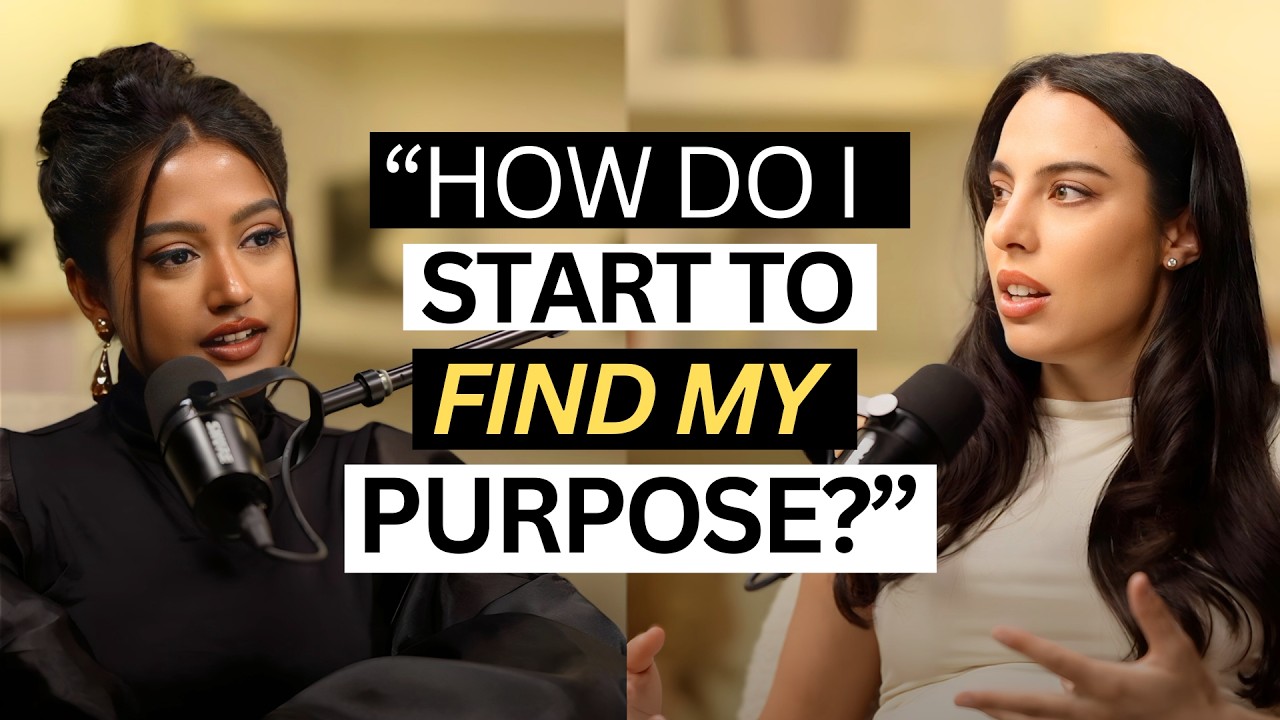
Rhea Jacobs is an entrepreneur, author, and founder based in Dubai. This conversation with Erica of The Balance Theory Podcast covers the myths around “finding your purpose,” the four purpose archetypes, the science of neuroplasticity, and the two kinds of fear.
Why You Feel Lost Even When You’ve Done Everything Right
Erica: Why do we feel so lost when it feels like we’ve done everything right? We’ve got the checklist, the goals, the job — but something still feels empty.
Rhea: If you’re in that phase where you feel lost but feel like you’re doing everything right according to the book — I have great news for you. You’re on the verge of a breakthrough.
Here’s why. There are two paths. The first is that you feel lost but lack the emotional intelligence to process that feeling — so you just keep going, and you think, “Maybe I’ll feel happy after I get that job,” or “I’ll feel at ease once I hit a certain number.” The second is that you have the emotional intelligence to say: I’m not happy. And you realize that all this while, you’ve been chasing external validation instead of trying to fulfill who you are inside.
That’s where purpose comes in. Purpose lives on a path of alignment. In life, we’re all handed a blueprint — zero to eighteen you’re in school, eighteen to twenty-four you’re in university, then you work until you’re sixty, and hopefully you have a nice house and kids to come home to. But I think that model is now obsolete. Because of the access we have, the conversations, the information — people are creating their own timelines. Someone might achieve their life goals at eighteen. Others discover theirs at eighty. The point is: you don’t have to seek external validation. Alignment is more essential than the checklist.
Purpose Is Not One Thing
Erica: I’ve met people in Dubai who’ve achieved extreme wealth very young and still feel unfulfilled. Is purpose this one big thing we need to define?
Rhea: I think the concept of purpose itself needs to be redefined. Purpose was marketed as this magnanimous thing — like maybe you’d go on a trek to the Himalayas and some wise person would descend from the heavens and say, “Ria, this is your purpose.” That’s how it was shown to us.
But the biggest misconception is that we’re all meant to have just one purpose. You and I — we’re not only wives or mothers. We’re friends, sisters, professionals. If we have so many roles, how can our purpose be just one thing?
The beauty of purpose is that it can be found in the most simple, pure moments of life — not just the grand gestures. And it evolves. You might start with one goal, but as you grow, that same goal slowly transforms. There’s magic in that.
I actually like a piecemeal approach to purpose. It takes the pressure off. Instead of asking “What is my one mission statement that defines me?”, you ask: what does purpose look like for me in this area of my life, right now?
Start With Self-Awareness
Erica: For someone feeling really unfulfilled right now — where do they start?
Rhea: The number one thing is self-awareness. In order to build the life you want, you need to know the tools you already have and the tools you still need. It’s easier to look outside — to chase that next goal — but you first need to look at where you lack and where your strengths are.
There’s internal self-awareness — knowing who you are without the noise of the world — and external self-awareness, because you’re not always right. Your ego gets in the way. A balance of the two is essential.
And this connects to inner-child work, to healing. These might seem unrelated to purpose, but they are literally your foundation. If your foundation is a shaky foundation, how do you expect to build your purpose on top of it?
The first step toward identifying your purpose is to ask three questions:
- Who am I? — your awareness, your strengths, your values
- What is my contribution? — what skills do I have, what legacy do I want to leave?
- How can that help the world around me?
And by “the world,” I don’t mean you have to impact millions of people. That world can be your children, your family, your colleagues. My mom’s purpose was always to be a mother. Because of what she gave me, I’m able to go out and create my own purpose. That in itself is a purpose.
The Four Purpose Archetypes
To help people identify how their purpose shows up, I created four archetypes:
- The Innovator — a pioneer whose ideas move the world forward
- The Healer — someone with deep empathy who wants to bring joy, comfort, and teaching to people
- The Strategist — someone who gets things in order, who can take a problem and map out a clear, step-by-step solution
- The Caregiver — teachers, mentors, mothers; people for whom purpose is about community, about making everyone feel seen and heard
You don’t have to be just one. You might be a caregiver at home, a strategist at work, and an innovator in your creative work. That’s not diluting your purpose — that’s strategizing it. Knowing which mode you’re in helps you show up as the best version of yourself in each space.
You Don’t Have to Finish Healing Before You Start
Erica: Do you need to feel grounded and aligned before you can identify your purpose? Or can you do both at once?
Rhea: Growth and change are integral to every phase of life. There’s no step-by-step routine. It’s in the now.
A lot of times we prolong important decisions because we say, “After I heal myself, I’ll find my purpose.” But you’re always healing. Healing is not a linear phase — it’s a constant cycle. You don’t need to do A to achieve B. They coincide with each other.
Life is a constant journey of learning and relearning and unlearning. If you’re starting from scratch today with no self-awareness, then yes, begin there. But if you’re already on a path, you can go back and recalibrate at any point. There’s no right or wrong direction of entry.
Ancient Wisdom on Purpose
Erica: What can ancient traditions teach us about purpose that we’re getting wrong in the modern world?
Rhea: The modern, western definition of purpose is extremely individualistic. Ancient traditions offer something different.
The Zulu community has the concept of Ubuntu: “I am because we are.” In that worldview, your purpose is aligned with your whole community — whatever you do must benefit everyone around you. It’s a beautiful counterweight to the achievement-focused individualism we’ve inherited.
The ancient Greeks had the concept of Arete — the idea that purpose is not primarily about wealth or status, but about the constant journey of improving who you are and your skills. Excellence as a way of life.
And most people know Ikigai, the Japanese framework: what you love, what you’re good at, what the world needs, and what you can be paid for. Purpose lives at the intersection of all four.
Different frameworks will resonate with different people. The point is that when you zoom out, you can take what works for you.
The Science: Neuroplasticity and Visualization
Rhea: Neuroplasticity is the brain’s ability to grow and evolve — something researchers once didn’t believe was possible past childhood. We now know the brain can change throughout your life.
This is why visualization works. When you focus on a goal, your brain rewires itself to constantly seek that thing in every interaction. Have you ever decided to buy a specific car and then suddenly you see that car everywhere? The cars didn’t multiply — your brain just started noticing them.
So if you write down your goals, visualize what you want, and put your attention on it — your brain learns to look for the opportunities to make it happen. Your thoughts and your actions still have to match. But the direction is set by what your brain is oriented toward.
The inverse is also true. When you’re having a terrible day and thinking everything is going wrong, your brain keeps finding more evidence that everything is going wrong. The event didn’t change — your expectation and attention did.
Two Kinds of Fear
Erica: How do we distinguish between fear that keeps us safe and fear that keeps us small?
Rhea: Fear is not the enemy — for generations, it’s helped us survive. But there are two kinds.
The first is useful fear — it has momentum. Say you want to quit your job. This fear says: okay, build a financial cushion first. Look for other opportunities. Make a plan. It doesn’t stop you from moving. It guides you.
The second is stagnant fear — it freezes you. Who’s going to hire you? Where will you go? Stay where you are. It keeps you locked in place.
The indicator is simple: does this fear move you forward, or does it stop you entirely? Anything that’s stagnant rots — water, food, anything. Momentum is essential for growth.
And I want to add: fear is often mistaken for a signal that you’re not ready, not capable, not worthy. But every single person who has ever done anything significant has experienced fear. By definition, stepping outside of your comfort zone feels uncomfortable. That discomfort is not a sign you’re unworthy — it’s simply a sign that you’re somewhere new.
Erica: What’s the one takeaway you want to leave with listeners?
Rhea: You are the artist to this canvas called life — and it’s time you took charge.
Only about 25% of the world’s eight billion people know what their purpose is. Purpose was packaged as this unattainable, magnanimous thing that only a privileged few could access. It’s time to change that narrative. Your purpose can be as grand or as simple as you choose. Both are valid. Both are enough.